
India is rapidly expanding its solar energy capacity to meet growing power demands and sustainability goals. Large-scale solar parks and utility-scale solar plants play a vital role in this transition. However, maintaining optimal performance across thousands of solar panels is a major challenge. Issues like hotspots, defective modules, wiring faults, and dust accumulation can drastically reduce energy output. This is where drone-based thermal inspection technology becomes a game changer.
At Garud Survey Private Limited, drone-based thermal inspections are transforming how solar parks monitor performance, reduce losses, and significantly improve overall efficiency.
Challenges Faced by Solar Parks
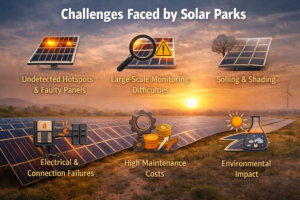
Solar parks operate under harsh environmental conditions such as high temperatures, dust, humidity, and seasonal weather variations. Over time, these factors lead to:
Hotspots caused by micro-cracks or faulty cells
Inverter and junction box overheating
Loose or damaged electrical connections
Panel shading and soiling issues
Gradual performance degradation
Manual inspection of thousands of panels is time-consuming, expensive, and often inaccurate. Undetected faults can lead to power loss, safety risks, and long-term equipment damage.
What Is Drone-Based Thermal Inspection?
Drone-based thermal inspection uses unmanned aerial vehicles (UAVs) equipped with thermal infrared cameras to capture temperature variations across solar panels. Healthy panels show uniform temperature patterns, while faulty panels appear as hotspots in thermal images.
These inspections allow solar park operators to quickly detect invisible issues that cannot be identified through visual inspection alone.
How Drone-Based Thermal Inspection Improves Solar Plant Efficiency
1. Early Detection of Faults
Thermal drones identify faulty cells, damaged modules, and electrical issues at an early stage. Timely repairs prevent minor defects from turning into major failures, ensuring maximum energy output.
2. Accurate Hotspot Identification
Hotspots significantly reduce panel efficiency and can cause permanent damage if ignored. Drone-based thermal imaging accurately pinpoints hotspot locations, allowing targeted maintenance instead of blanket replacements.
3. Reduced Power Loss
By detecting underperforming panels quickly, operators can restore efficiency faster. Even a small percentage of power loss across a large solar park results in significant revenue loss. Thermal inspections help recover lost energy and improve ROI.
4. Faster & Safer Inspections
Traditional manual inspections require technicians to walk across large solar fields, increasing inspection time and safety risks. Drone inspections cover hundreds of acres in a single day, eliminating physical risk and reducing downtime.
5. Cost-Effective Maintenance Planning
Drone thermal data enables predictive maintenance. Instead of reactive repairs, solar park operators can schedule maintenance based on accurate data, reducing operational and maintenance costs.
Advantages Over Traditional Inspection Methods
Drone-based thermal inspections offer several advantages:
Non-contact and non-invasive inspection
High-resolution thermal and visual data
Minimal disruption to plant operations
Faster reporting and analysis
Suitable for both rooftop and utility-scale solar parks
This technology ensures higher accuracy and consistency compared to manual inspections.
Role of Advanced Data Analytics
At Garud Survey Private Limited, drone inspections are supported by advanced data processing and analytics. Thermal images are analyzed to:
Classify fault severity
Identify recurring issues
Generate geo-referenced inspection reports
Provide actionable maintenance insights
This data-driven approach helps solar park owners make informed decisions to enhance plant performance.
Supporting India’s Renewable Energy Goals
Drone-based thermal inspection aligns perfectly with India’s renewable energy initiatives by:
Increasing solar power generation efficiency
Reducing energy losses
Improving asset lifespan
Supporting sustainable energy infrastructure
As solar parks continue to expand across India, technology-driven monitoring will be essential for long-term success.
Conclusion
Maintaining high efficiency in large solar parks is impossible without advanced inspection methods. Drone-based thermal inspections provide the fastest, safest, and most accurate way to detect faults, reduce losses, and improve solar plant performance.
With expertise in drone surveying and thermal inspection services, Garud Survey Private Limited delivers reliable solutions that help solar park operators maximize efficiency and profitability. By adopting drone-based thermal inspection technology, solar power producers can ensure consistent performance, longer asset life, and a higher return on investment.

