Water scarcity has become one of the biggest challenges in India due to rapid urbanization, groundwater depletion, and irregular rainfall patterns. Rainwater harvesting is one of the most effective solutions to restore groundwater levels, but its success depends on identifying the right rechargeable points beneath the surface. This is where ERT (Electrical Resistivity Tomography) technology plays a vital role.
Garud Survey Private Limited is a leading provider of advanced geophysical survey solutions in India, helping industries, government bodies, and infrastructure developers locate scientifically accurate recharge zones using modern ERT technology.
Understanding ERT Technology
Electrical Resistivity Tomography (ERT) is a geophysical method used to measure the resistivity of subsurface materials. In simple terms, it helps experts understand what lies beneath the ground without excavation.
Different soil and rock types have different electrical resistivity values. For example:
- Clay has low resistivity.
- Dry rocks have high resistivity.
- Water-bearing formations show distinct resistivity patterns.
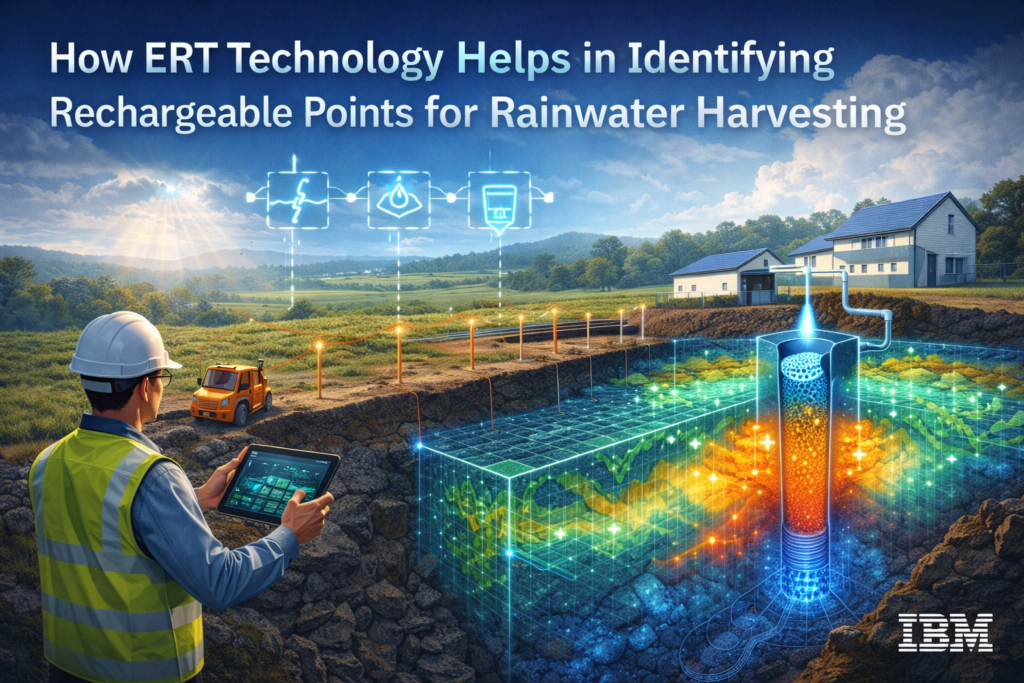
By analyzing these variations, ERT technology creates a 2D or 3D image of underground layers, helping identify aquifers, fractures, porous zones, and permeable formations that are ideal for groundwater recharge.
Why Identifying Rechargeable Points is Important
Rainwater harvesting structures such as recharge wells, percolation pits, and recharge shafts must be constructed at scientifically suitable locations. Random installation can lead to:
- Poor water absorption
- Structural failure
- Wasted investment
- No improvement in groundwater levels
To ensure long-term sustainability, recharge structures must connect directly with permeable zones or fractured rock formations that allow water to percolate efficiently.
This is exactly where Garud Survey Private Limited uses ERT surveys to provide precise data-driven solutions.
How ERT Helps in Rainwater Harvesting Projects
1. Locating Water-Bearing Fractures
In hard rock areas, groundwater mainly exists in fractures and weathered zones. ERT helps detect:
- Fracture zones
- Weathered rock layers
- Saturated formations
By targeting these zones, recharge wells can directly feed water into productive aquifers.
2. Identifying Soil Permeability
Not all soils allow water infiltration. Clay-rich areas prevent percolation, while sandy or gravelly formations allow rapid recharge.
ERT helps:
- Differentiate clay layers from sandy layers
- Detect impermeable barriers
- Identify ideal infiltration zones
This ensures rainwater is not trapped at shallow levels but moves efficiently into deeper groundwater systems.
3. Determining Depth of Aquifer
Rainwater harvesting structures must be designed according to aquifer depth. If the recharge system is too shallow, it may not connect with the main aquifer.
ERT surveys provide:
- Depth estimation of aquifers
- Thickness of weathered zones
- Groundwater table levels
This information allows engineers to design recharge wells with optimal depth and diameter.
4. Avoiding Contamination Risks
Recharge structures must not connect polluted surface water directly to drinking aquifers. ERT helps map underground stratification and ensures:
- Safe recharge zones
- Protection of potable groundwater
- Sustainable water management
Garud Survey Private Limited ensures that every ERT survey considers environmental safety standards.
Advantages of Using ERT for Rainwater Harvesting
✔ Non-Destructive Investigation
ERT does not require digging or drilling during the survey phase.
✔ Cost-Effective Planning
Scientific identification reduces trial-and-error costs.
✔ High Accuracy
Modern ERT equipment provides reliable subsurface imaging.
✔ Time Saving
Quick data acquisition and interpretation accelerate project execution.
✔ Sustainable Results
Properly identified recharge zones ensure long-term groundwater improvement.
Applications Across India
ERT technology is highly effective in diverse Indian terrains, including:
- Urban smart city projects
- Industrial campuses
- Residential townships
- Agricultural lands
- Mining and infrastructure projects
In regions facing groundwater depletion, especially in semi-arid zones, scientific recharge planning has become essential. Garud Survey Private Limited has been actively supporting sustainable water management initiatives across India by offering advanced ERT-based groundwater investigation services.
The Role of Technology in Sustainable Water Management
Traditional methods of identifying recharge points relied heavily on local knowledge and trial drilling. However, with increasing groundwater stress, scientific tools are necessary.
ERT technology bridges the gap between guesswork and precision. It provides visual subsurface mapping that enables:
- Evidence-based decision making
- Efficient rainwater harvesting design
- Long-term aquifer sustainability
- Reduced groundwater depletion
By integrating geophysical surveys with hydrological planning, Garud Survey Private Limited ensures that rainwater harvesting projects deliver measurable and sustainable results.
Why Choose Garud Survey Private Limited?
Garud Survey Private Limited stands out in the field of geophysical and drone-based surveys due to:
- Advanced ERT survey equipment
- Experienced geophysicists and engineers
- Accurate data interpretation
- Pan-India project execution capability
- Commitment to sustainable development
The company combines innovation with practical expertise to provide customized groundwater recharge solutions for industries, government departments, and private clients.
Conclusion
Rainwater harvesting is not just about collecting water; it is about recharging the right underground formations. Without scientific identification of permeable zones and aquifers, recharge structures may fail to achieve desired results.
Electrical Resistivity Tomography (ERT) technology offers a reliable and accurate method to identify rechargeable points beneath the surface. By mapping subsurface geology and detecting water-bearing formations, ERT ensures that rainwater harvesting systems are strategically placed for maximum impact.
With advanced technology and expert analysis, Garud Survey Private Limited plays a crucial role in strengthening groundwater resources and promoting sustainable water management across India.
Investing in ERT-based surveys today means securing water resources for tomorrow.